Chile has the best internet in Latin America. Bolivia has the interesting story.
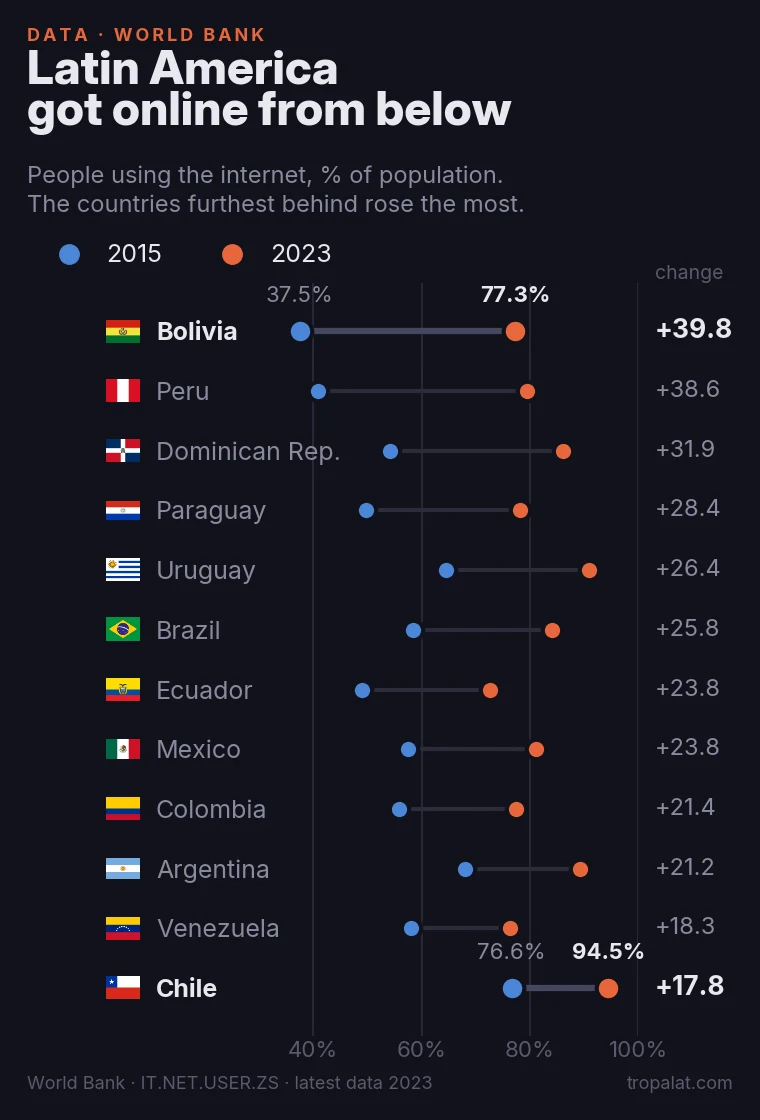
If the question is who leads, the answer is short: Chile, with 94.5% of the population using the internet. Behind it come Uruguay (90.9%) and Argentina (89.2%). Last in the group is Ecuador, at 72.7%.
But that snapshot hides what actually happened.
Between 2015 and 2023, the country that moved most was Bolivia: from 37.5% to 77.3%. Almost forty points in eight years, more than double. Peru rose 38.6 points. The Dominican Republic, 31.9. And Chile, first in the table? It rose 17.8, the least of all.
It is not that Chile stood still. It is that there was hardly anyone left to connect. The ones behind are the ones that ran.
What matters is HOW they ran, because it was not by cable.
The Dominican Republic has 86.1% of people online, but only 11.1 fixed broadband connections per 100 inhabitants. Peru: 79.5% connected, 10.4 fixed connections. Bolivia: 77.3% and 11.2. Compare Uruguay, with 32.4 fixed connections per 100 people, three times Peru's.
The difference is mobile. The Dominican Republic has 92 lines per 100 inhabitants; Colombia, 167.
The region did not get online by running cable into houses. It got online by phone.
And one year stands out. Bolivia had been climbing slowly, three or four points a year, until it sat at 47% in 2019. In 2020 it jumped to 60%. Thirteen points at once. Peru, already rising five points a year, kept its pace without a jolt. The pandemic did not push everyone equally: it pushed hardest where the gap was widest.
This is not a technology figure, it is a figure about how people live. Latin American internet is mobile, almost always prepaid, and often the phone is the only computer in the house. It is used standing up, on whatever signal there is, spending data that gets counted.
That is why a page that only works well on a big screen with fibre does not, for most of the region, exist at all.
Data: World Bank, indicators IT.NET.USER.ZS, IT.NET.BBND.P2 and IT.CEL.SETS.P2. Latest year available: 2023.